

The digital lock that protects the world’s money and secrets is starting to creak. Until recently, modern cryptography seemed like an insurmountable mountain for our computers. But two research groups have just announced that they have found a dangerous shortcut.
This is not about new hardware, but about a brutally efficient mathematical optimization that drastically reduces the number of qubits required to break today’s codes.
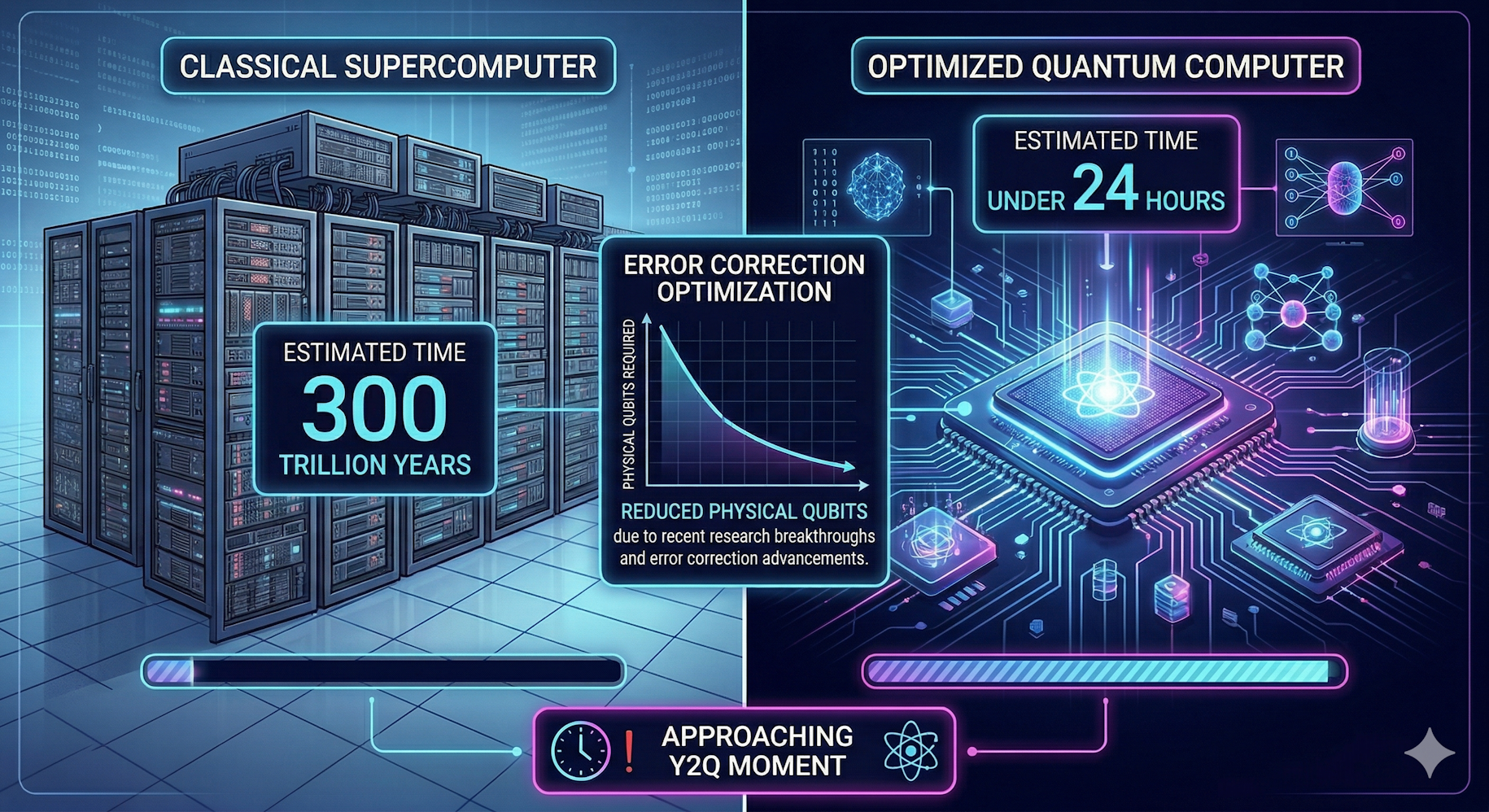
The protective wall of the internet, the famous RSA algorithm, relies on a simple barrier: it is almost impossible to factor a huge number into its prime components. A classical supercomputer would need thousands of years to crack a standard key. In the quantum world, however, the rules change. Qubits can explore all possible solutions simultaneously, turning millennia of computation into minutes of processing.
The major problem of quantum computers until now has been “noise.” Environmental disturbances quickly destroy information, forcing researchers to use millions of qubits solely for error correction.
The new protocols announced this week (March 30 – April 5) radically change the equation. By making error correction more efficient, the hardware threshold required to compromise global security has dropped dangerously low.
This breakthrough forces an urgent transition to post‑quantum cryptography. It is no longer a theoretical debate about the future, but an immediate necessity for banks and governments.
New security standards, based on lattice‑based mathematical structures, are the only ones capable of withstanding the assault of increasingly efficient quantum machines. The time when classical keys were secure is ending much sooner than experts anticipated.
To better understand the scale of this technological leap, you can explore below the massive difference in power between traditional and quantum methods.
Sources:
- https://www.quantamagazine.org/new-advances-bring-the-era-of-quantum-computers-closer-than-ever-20260403/
- https://www.nature.com/articles/s41586-024-quantum-error-correction
- https://csrc.nist.gov/projects/post-quantum-cryptography
Cover Photo by Mahesh Ranaweera