

“Happy are those conscious of their spiritual need.” (Matthew 5:3)
Human existence is fundamentally defined by the search for absolute fulfillment which is a state of relative permanence and intense joy, an equilibrium entirely free from the volatile oscillations of temporal circumstances. Happiness is still the central focus of human intellectual and spiritual inquiry.
To comprehensively grasp the architecture of this profound state, we must go beyond the boundaries of abstract thought and to move seamlessly from classical philosophical reflections to the absolute axioms of theology.
Ultimately, we must translate these concepts into the rigorous syntax of mathematical topology and algorithmic logic. The synthesis of these disciplines reveals that true happiness is not a random occurrence or a subjective emotion; it is a precise alignment with an universal constant.
Table of Contents
The Philosophical Search for an Elusive Equilibrium
The greatest minds of antiquity and modernity dedicated their lives to isolating this notion. And they constructed vast intellectual frameworks to define human purpose.
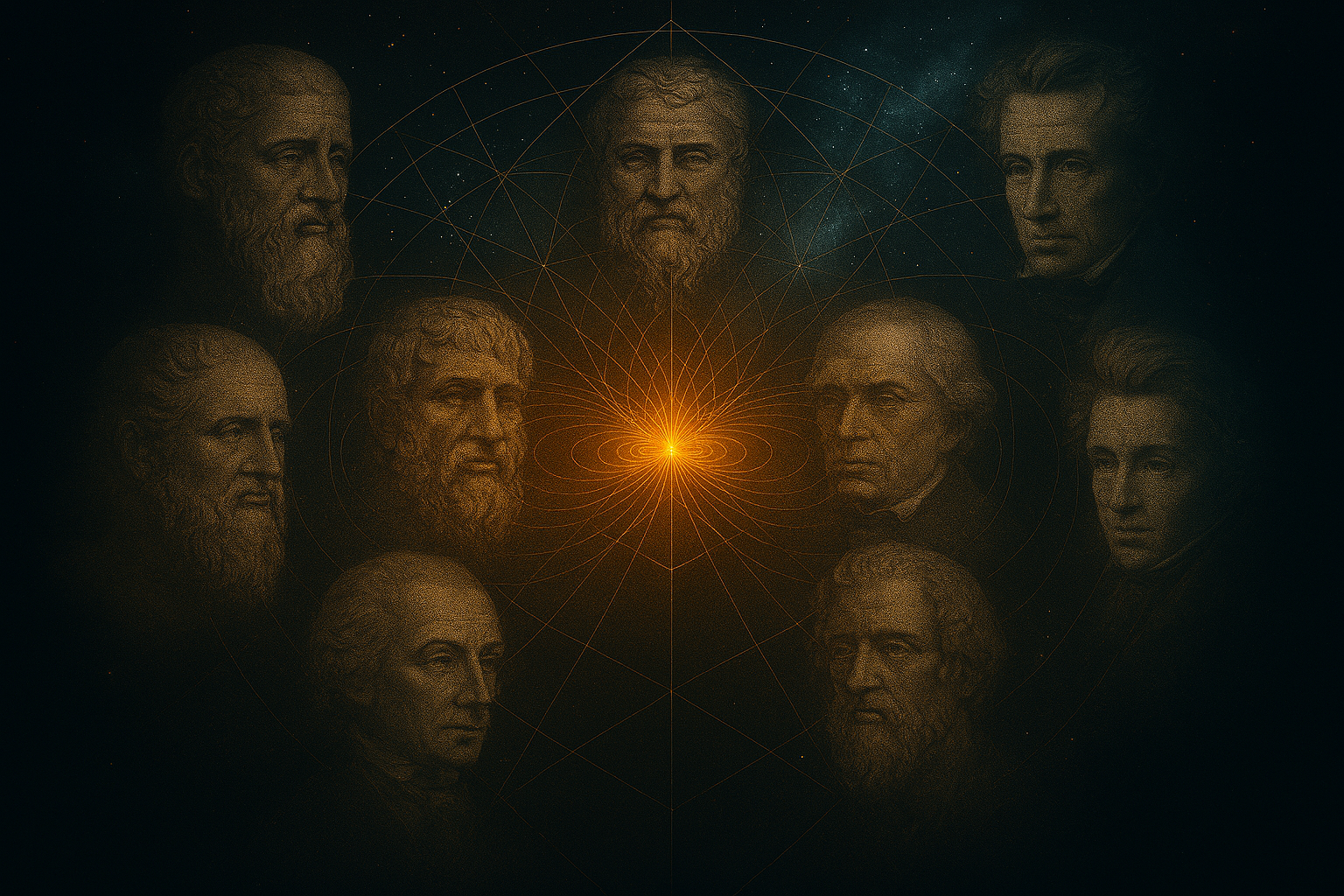
Plato viewed happiness as the ultimate harmony of the human soul. He posited that human reason must absolutely and unwaveringly govern both the spirit and the appetite. Thus, an internal order that reflects the perfect forms of the cosmos would be created.
His intellectual successor, Aristotle, defined it as eudaimonia.It is the active and rational exercise of virtue over a complete life. For Aristotle, it was not a fleeting feeling but the ultimate end of human endeavor; eudaimonia became a state achieved only through the rigorous cultivation of moral excellence and intellectual contemplation.
Epicurus actually sought ataraxia, not the advocacy base pleasure, What was his idea? That it was a profound peace achieved by the careful elimination of physical pain and mental anxiety. He valued quiet contemplation, simple friendships, and the absence of fear above indulgent excess, thus recognizing that unchecked desires lead inevitably to suffering.
Seneca argued for a life lived in perfect accordance with nature and divine reason. He placed ultimate value on unshakeable inner virtue, completely immune to external circumstances. He taught that the wise person finds total self-sufficiency within their own reasoned responses to adversity.
In the modern era, Immanuel Kant sharply separated the pursuit of physical desire from pure moral duty. He argued that one must act out of pure duty to the moral law to become worthy of happiness, rather than chasing the psychological feeling directly. The universal law of moral imperative must govern action independent of personal inclination.
John Stuart Mill shifted the philosophical focus to the collective human experience. He formulated the utilitarian ideal in his attempting to quantify moral actions by their aggregate societal outcomes. And finally, Søren Kierkegaard saw the profound despair inherent in purely human, aesthetic pursuits. He demanded a leap of faith, a passionate and absolute individual commitment to the divineand asserted that true selfhood and joy are found only in an absolute relation to the Absolute.
Theological Axioms and the Architecture of the Mount
These philosophical towers point toward the Heaven, brilliant but ultimately bounded by human logic and the limitations of mortal perception. The teachings delivered in the Sermon on the Mountbring the architecture of the infinite down to the terrestrial sphere, completely subverting conventional human metrics of success and fulfillment. The declarations made on the Galilean hillside, commonly known as the Beatitudes, function as divine, unalterable axioms. They establish the foundational truths for a state of being completely insulated against temporal suffering, redefining the parameters of human well-being entirely in relation to a Higher Being.

“Happy are those conscious of their spiritual need,” the sermon begins. Awareness of spiritual destitution… This profound consciousness acts as the primary catalyst for true joy. The entirely self-sufficient find no room within themselves for the divine presence. The text frames human incompleteness not as a fundamental flaw, but as the necessary receptacle for absolute truth. By recognizing personal insufficiency, the individual opens the internal architecture to external, perfect completion.
The subsequent axioms continue to shatter secular reasoning. “Happy are those who mourn.” This is the paradox that defies earthly logic. The mourning is a deep grief over human imperfection and separation from the divine standard. Man in this state draws the ultimate divine comfort. The comfort itself generates a permanent, indestructible joy that external forces cannot erode. “Happy are the mild-tempered,” denoting a controlled strength yielded entirely to the will of the Higher Being. This mildness, a deliberate restraint and submission to the Divine, inherits the ultimate promises of the Creator, Jehovah. Furthermore, the “pure in heart” are individuals defined by an unadulterated and single-minded devotion. They only are granted the ultimate intellectual and spiritual vision of the Creator.
These axioms anchor human happiness strictly to the eternal constant and they prove that true joy and happiness requires the abandonment of the transient self for the Higher Being.
The Theorem of Happiness and Topological Convergence
To elevate these concepts beyond abstract language, one must translate this theological absolute into the pure, rigorous logic of advanced mathematics. We formally postulate the Theorem of Happiness, a model demonstrating that the existence and uniqueness of absolute joy and happiness are only mathematically viable in relation to a Higher Being.
Consider the sum of human experience and spiritual states as a mathematical space. We define this construct as a metric space, a set $X$ equipped with a specific distance function $d$, which measures the degree of separation between any two states of being.
Every human action, thought, and spiritual condition represents a distinct point within this multidimensional space. Humans inherently seek a sequence of actions that converges to a fixed point of absolute joy. Within a purely secular, material existence, this framework constitutes an incomplete metric space. The sequences of human desires and worldly pursuits, our existential Cauchy sequences, never reach a limit within the boundaries of the system itself. They diverge into infinity or oscillate endlessly between temporary satisfaction and profound despair, lacking an absolute reference point to anchor the sequence.
The absolute and perfect Creator provides the necessary boundary condition to complete this space. The flawless standards of the divine establish the ultimate, unmoving coordinate that makes mathematical convergence possible. We apply the rigorous logic of the Banach Fixed-Point Theorem to this existential problem. This fundamental principle of functional analysis states that a contraction mapping on a complete metric space guarantees the existence of exactly one unique fixed point.
Our function of spiritual alignment, the daily obedience to the divine will, acts exactly as the contraction mapping $T$. With each application of this function—each decision made in harmony with the divine axioms—the distance between our current state and the divine standard strictly decreases. The mathematical inequality holds true:
$d(T(x), T(y)) \le k \cdot d(x, y)$,
where the constant $k$ (the Lipschitz constant) is strictly less than one. This $k$ represents the degree of human submission to the divine will. Because the space is completed by the presence of the Higher Being, the fixed point $x^*$ definitively exists. Furthermore, the uniqueness of this point is guaranteed. There can be only one state of absolute happiness, defined entirely by the coordinate system of the Creator. Any attempt to find a secondary fixed point of happiness outside this relation violates the fundamental axioms of the completed space.
Network Dynamics and the Utopic Convergence Model
We gracefully extend this theorem to construct the mathematical model of a utopic society, utilizing the complex tools of dynamical systems and graph theory. Let this utopic society be represented as a complex network, a directed graph $G = (V, E)$. The vertices $V$ represent the individual human minds, while the edges $E$ represent their continuous, dynamic social interactions. Each individual node possesses a state vector, a multidimensional numerical representation of their moral and spiritual alignment at any given discrete time $t$.
In an isolated social system without a central, divine attractor, the network inevitably degrades. Entropy strictly increases, leading to social friction, moral decay, and eventual systemic collapse. The differential equations governing such a system lack a stabilizing equilibrium. However, the Higher Being functions as a global, immutable attractor within the mathematical model. We introduce this divine presence as a uniform, perfect vector field operating uniformly across the entire societal network.
The governing ordinary differential equation for individual $i$ fundamentally changes to incorporate this reality:
$dx_i/dt = f(x_i) + \sum a_{ij}(x_j – x_i) + C(H – x_i)$.
The term $f(x_i)$ represents the internal drive. The summation represents the social influence from peers within the graph. The critical, stabilizing term is $C(H – x_i)$. The constant $C$ represents the coupling strength—the societal devotion to the divine—and $H$ is the absolute vector of the Higher Being. Under the influence of this perfect attractor, the entire social system enters a state of global asymptotic stability. Local perturbations, such as individual errors or external shocks, are rapidly dampened by the overwhelming pull of the divine vector field. All state vectors within the network eventually align, vibrating at the exact frequency of the perfect baseline.
Algorithmic Implementation of Societal Synchronization
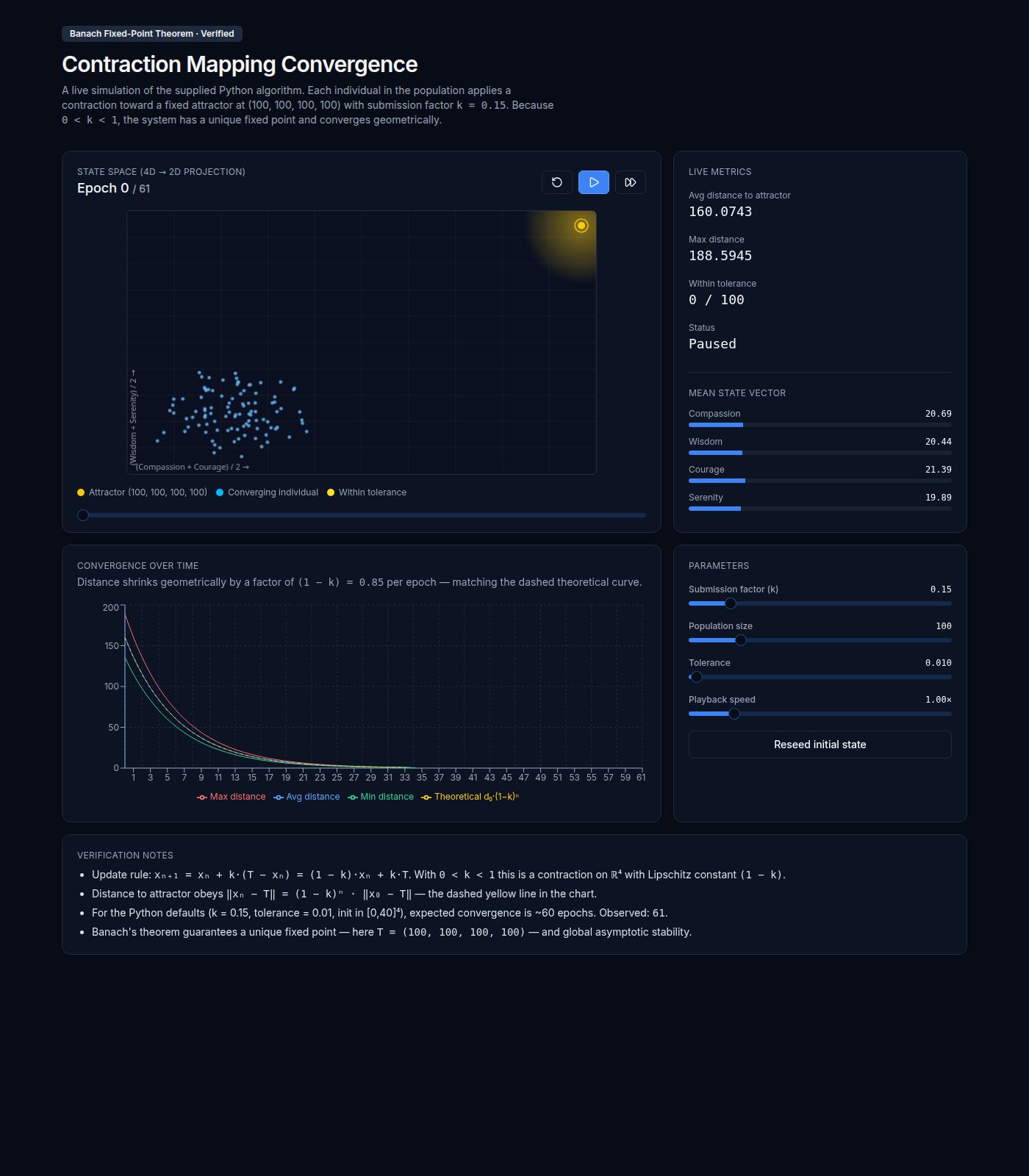
This theoretical topological model requires a practical, algorithmic manifestation to prove its computational validity. The following Python simulation explicitly demonstrates this exact societal synchronization. The code defines variables representing the human individuals, their initial chaotic and divergent states, and the singular, perfect divine constant. The algorithm iterates to demonstrate the inevitable convergence to the unique fixed point of societal happiness, proving the application of the contraction mapping over successive epochs.
Check it in Replit,and also check the visualization.
import math
import random
class HigherBeing:
"""
The Absolute Creator, representing the fixed point of perfect happiness.
In this dynamical system, the Creator is the immutable global attractor.
"""
def __init__(self):
# The vector of absolute perfection (representing universal virtues)
self.divine_vector = [100.0, 100.0, 100.0, 100.0]
def get_standard(self):
return self.divine_vector
class Individual:
"""
A human entity within the metric space, seeking the fixed point of joy.
"""
def __init__(self, id_num):
self.id = id_num
# Initial state: random worldly values representing an incomplete space
self.state_vector = [
random.uniform(0, 40),
random.uniform(0, 40),
random.uniform(0, 40),
random.uniform(0, 40)
]
self.is_happy = False
def apply_contraction_mapping(self, divine_standard, submission_factor):
"""
The mathematical alignment to the Higher Being.
The submission_factor (k) must be strictly < 1 to satisfy the
Banach Fixed-Point Theorem constraints.
"""
for i in range(len(self.state_vector)):
# The Euclidean distance decreases strictly with each application
distance = divine_standard[i] - self.state_vector[i]
self.state_vector[i] += distance * submission_factor
def calculate_euclidean_distance(self, divine_standard):
""" Calculates the distance to the absolute truth in the metric space. """
squared_diffs = [(divine_standard[i] - self.state_vector[i])**2 for i in range(len(self.state_vector))]
return math.sqrt(sum(squared_diffs))
class UtopicSociety:
"""
The directed graph network G(V, E) conforming to the Theorem of Happiness.
"""
def __init__(self, population_size):
self.creator = HigherBeing()
self.population = [Individual(i) for i in range(population_size)]
self.k = 0.15 # Contraction constant representing spiritual submission
self.tolerance = 0.01 # The numerical threshold for achieving the fixed point
self.epoch = 0
def simulate_epoch(self):
""" Simulates one unit of time in the non-linear dynamical system. """
self.epoch += 1
divine_standard = self.creator.get_standard()
system_stable = True
for person in self.population:
# The individual node aligns with the global attractor field
person.apply_contraction_mapping(divine_standard, self.k)
# Verify mathematical convergence
dist = person.calculate_euclidean_distance(divine_standard)
if dist > self.tolerance:
system_stable = False
else:
person.is_happy = True
return system_stable
def execute_convergence(self):
""" Executes the algorithm until global asymptotic stability is reached. """
print("Initiating mathematical alignment of the social network...")
# Log the chaotic initial state
initial_dist = sum([p.calculate_euclidean_distance(self.creator.get_standard()) for p in self.population]) / len(self.population)
print(f"Epoch 0: Average societal distance from Absolute Joy: {initial_dist:.4f}")
is_stable = False
while not is_stable and self.epoch < 100:
is_stable = self.simulate_epoch()
if self.epoch % 10 == 0 or is_stable:
avg_dist = sum([p.calculate_euclidean_distance(self.creator.get_standard()) for p in self.population]) / len(self.population)
print(f"Epoch {self.epoch}: Average societal distance from Absolute Joy: {avg_dist:.4f}")
print("\nTheorem Proven. Unique Fixed Point Reached.")
print(f"Global asymptotic stability achieved at Epoch {self.epoch}.")
print("All network nodes have successfully aligned with the Absolute Constant.")
# Instantiate the algorithmic society model and execute the theorem
society = UtopicSociety(population_size=100)
society.execute_convergence()
The algorithmic execution relentlessly reduces the mathematical distance between human chaos and divine order. The variable of distance continuously shrinks at an exponential rate until it falls entirely below the tolerance threshold. The complex system finds perfect rest exactly at the coordinates of the Creator, proving that the fixed point is not only existent but inevitable under the correct parameters.
This synthesis of ancient philosophy, absolute theological axioms, real mathematical analysis, and computational logic points toward a singular, unavoidable truth. True happiness cannot be independently generated by the individual human node. It must be inherited and continuously synchronized from the ultimate architect of the network.
The divine teachings provided the original, unalterable documentation. The rigorous mathematics of topology and the algorithmic simulations simply prove that the function performs flawlessly when executed exactly as designed.
Check here the output of the Python code:
See one more visualizer:
The Theorem of Happiness Convergence Model
Epoch: 0 | Distance to Absolute: —
Reference Bibliography
- Kreyszig, Erwin. Introductory Functional Analysis with Applications. John Wiley & Sons, 1989.
- Rudin, Walter. Principles of Mathematical Analysis. McGraw-Hill Education, 1976.
- Strogatz, Steven H. Nonlinear Dynamics and Chaos: With Applications to Physics, Biology, Chemistry, and Engineering. CRC Press, 2014.
- Zalta, Edward N. (ed.). The Stanford Encyclopedia of Philosophy. Metaphysics Research Lab, Stanford University.
- Fieser, James, and Bradley Dowden (eds.). The Internet Encyclopedia of Philosophy.
- Weisstein, Eric W. MathWorld–A Wolfram Web Resource. Wolfram Research, Inc.