

Wooden-headedness, the source of self-deception… consists in assessing a situation in terms of preconceived fixed notions while ignoring or rejecting any contrary signs. It is acting according to wish while not allowing oneself to be deflected by the facts.
Barbara W. Tuchman, in her book The March of the Folly, defines irrational decision-making at the state level through three strict criteria: acting against self-interest, rejecting a viable alternative, and ignoring clear contemporary warnings.
We want to translate this historical truth into a precise mathematical model. Decision theoryand Bayesian calculus provide the framework to structure this concept and evaluate uncertainty.
We can call it the Theorem of Self-Destruction.
Table of Contents
The Utility Function and Negative Optimization
Let $U(S)$ be the utility function, a quantitative measure of a state’s welfare, economy, and security. The decision-making group has at its disposal the current policy $P_{folly}$ and an obvious alternative $P_{alt}$.
Irrational thinking is defined mathematically by the inequality $E[U(P_{folly})] \ll E[U(P_{alt})]$. Leaders repeatedly have chosen the trajectory with the lower expected value, even though objective data demonstrate the superiority of the other option.
Bayesian Blindness and the Rejection Factor ($\gamma$)
Bayesian updating, a logical algorithm for adjusting decisions based on new evidence, is essential for survival. In Tuchman’s book, new evidence ($I$) takes the form of reports and warnings from ambassadors or experts.
A rational decision-maker constantly calculates the probability of failure, evaluating $P(\text{Failure} | I)$. In our model of irrationality, we introduce the reality rejection factor. This is $\gamma$, with values between 0 and 1.
Therefore, the irrational leaderperceives the probability of failure as $\gamma \cdot P(\text{Failure} | I)$. When $\gamma$ approaches zero, the decision-making group mathematically cancels the evidence of an imminent disaster. These leaders isolate from reality.
Structural Rigidity in Markov Chains
The author emphasizes a key point: a group maintains this destructive policy beyond the term of a single leader. We can model this phenomenon through a Markov chain. In a functional system, a severe error triggers a rapid transition to a recovery policy. In historical irrational thinking, the destructive policy transforms into an absorbing state.
Thus, the probability of leaving the $P_{folly}$ trajectory becomes zero. The system remains stuck in a recursive loop of errors, no matter the actual collapse of the utility function $U(S)$.
The above framework demonstrates a vital truth: Historical irrationality is not an isolated calculation error, it is an intentional and systematic decoupling of correction mechanisms.
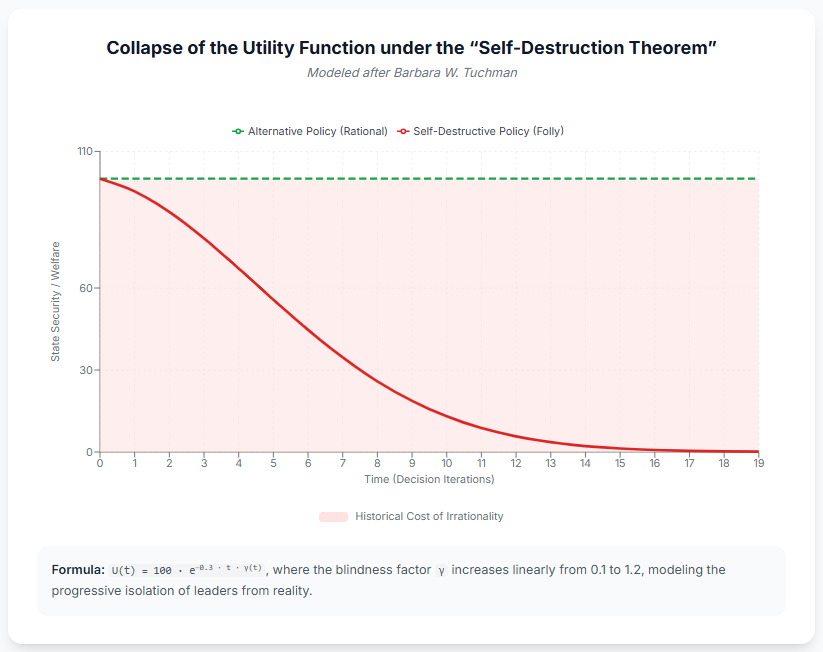
Here is the Python code that best describes the Theorem of Self-Destruction. This was done with Replit.
import numpy as np
import matplotlib.pyplot as plt
def simulate_folly_collapse():
# Time (years or consecutive iterations of poor decisions)
time_steps = np.arange(0, 20, 1)
# Base utility if the rational alternative were chosen (remains constant)
rational_utility = 100 * np.ones(len(time_steps))
# The blindness factor (gamma) that increases over time
# Leaders become increasingly isolated from reality.
gamma = np.linspace(0.1, 1.2, len(time_steps))
# Utility under the "March of Folly" drops dramatically as blindness persists
folly_utility = 100 * np.exp(-0.3 * time_steps * gamma)
# Creating the plot
fig, ax = plt.subplots(figsize=(10, 6))
# Drawing the lines
ax.plot(time_steps, rational_utility, label='Alternative Policy (Rational)', color='#2ca02c', linestyle='--', linewidth=2.5)
ax.plot(time_steps, folly_utility, label='Self-Destructive Policy (Folly)', color='#d62728', linewidth=3)
# Highlighting the loss area (The Cost of Folly)
ax.fill_between(time_steps, rational_utility, folly_utility, color='red', alpha=0.1, label='The Historical Cost of Irrationality')
# Customizing the plot
ax.set_title('Utility Function Collapse under the "Theorem of Self-Destruction"\n(Modeled after Barbara W. Tuchman)', fontsize=14, fontweight='bold')
ax.set_xlabel('Time (Decision Iterations)', fontsize=12)
ax.set_ylabel('State Security / Welfare', fontsize=12)
ax.set_ylim(0, 110)
ax.set_xlim(0, 19)
ax.grid(True, linestyle=':', alpha=0.7)
# Adding the legend
ax.legend(loc='center right', fontsize=10)
plt.tight_layout()
plt.show()
if __name__ == "__main__":
print("Generating the graphical visualization of the decision collapse...")
simulate_folly_collapse()
Here is the Replit output for this code:
Cover photo by Anton Massalov
Good sources for reading:
The Historical & Political Core
- Tuchman, B. W. (1984). The March of Folly: From Troy to Vietnam.
- Allison, G. T., & Zelikow, P. (1999). Essence of Decision: Explaining the Cuban Missile Crisis.
Utility Function & Decision Theory
- von Neumann, J., & Morgenstern, O. (1944). Theory of Games and Economic Behavior.
- Peterson, M. (2017). An Introduction to Decision Theory.
Bayesian Blindness & Cognitive Rejection
- Berger, J. O. (1985). Statistical Decision Theory and Bayesian Analysis. Springer.
- Kahneman, D. (2011). Thinking, Fast and Slow. Farrar, Straus and Giroux.
Structural Rigidity & Markov Chains
- Ross, S. M. (1996). Stochastic Processes. Wiley.
- Norris, J. R. (1998). Markov Chains.