

The inherent beauty of programming languages surpasses their mere functional utility. It manifests through the absolute clarity of syntax, an invisible architecture designed to order informational chaos.
Source code becomes a pure form of poetic expression, entirely devoid of the ambiguity of human words. Thus, this structural rigor functions as a superior art form, where logic substitutes classical metaphor.
Sorting algorithms, mathematical procedures designed to organize datasets, perfectly illustrate this algorithmic elegance. An algorithm such as QuickSort does not merely arrange numerical values in ascending or descending order. It reveals a hidden harmony, and it reduces a system’s entropy through a balanced divide et impera logic.
Therefore, mathematical rigor becomes the most faithful language for describing nature. Every complex structure in the universe gravitates toward an optimal state of order, exactly like a dataset processed algorithmically by a processor.
Table of Contents
The Invention of Prime Syntax
To explore this aesthetic deeply, the present study proposes the construction of an entirely new theoretical language. This formal system eliminates letters and rests exclusively on integers and arithmetic operations.
Mathematical thinking allows grammar to transform into an exact and immutable algebraic equation. Gottfried Wilhelm Leibniz anticipated this possibility in the seventeenth century through the concept of characteristica universalis, a universal alphabet of human thought intended to reduce any philosophical or linguistic dispute to a simple mathematical calculation.
Our contemporary project updates this theological and mathematical vision. Direct conceptual inspiration derives from Gödel numbering, a logical encoding method developed by the mathematician Kurt Gödel in 1931. This function associates a unique natural number with every symbol and every formula in a formal language.
This concept can easily extend to aesthetics and poetry. In this hypothetical language, called Prime Syntax, each basic word corresponds exclusively to a prime number.
Prime numbers, indivisible entities that form the foundation of all arithmetic, become the absolute vocabulary of the proposed language. The construction requires a fundamental dictionary. Thus:
- The concept “man”receives the value 2.
- The verb “to exist” receives the value 3.
- The noun “universe”receives the value 5.
- The verb “to dream” receives the value 7.
- The concept “infinite” receives the value 11.
Consequently, semantics becomes permanently isolated in the indivisible purity of prime factors.
The Grammatical Architecture through the Fibonacci Sequence
To establish subordinate relations within a sentence, grammar relies on conjunctions, prepositions, and case inflections. Prime Syntax uses exponentiation to define hierarchy and syntactic roles.
To preserve harmony with the laws of physics, exponents follow the Fibonacci sequence. This mathematical series in which each number equals the sum of the two preceding ones governs the natural growth of biological structures, from the arrangement of leaves on a stem to the shape of galactic spirals.
Its application to syntax imprints a cosmic proportion on the generated sentences. Grammatical functions receive specific Fibonacci exponents.
- The subject of the sentence receives exponent 1.
- The predicate, the nucleus of the action, receives exponent 2.
- The direct object, the entity on which the action falls, receives exponent 3.
- The attribute or adverbial modifier receives exponent 5.
A sentence is no longer written linearly on a page. It is computed as the mathematical product of these factors raised to their syntactic powers.
The sentence equation takes the form:
$$N = p_1^{f_1} \times p_2^{f_2} \times \dots$$
where $p$ is the prime word and $f$ is the Fibonacci exponent corresponding to its function.
Mathematical Modeling of Poetry
The analysis of a poetic sentence generated according to this pattern clarifies the theoretical model.
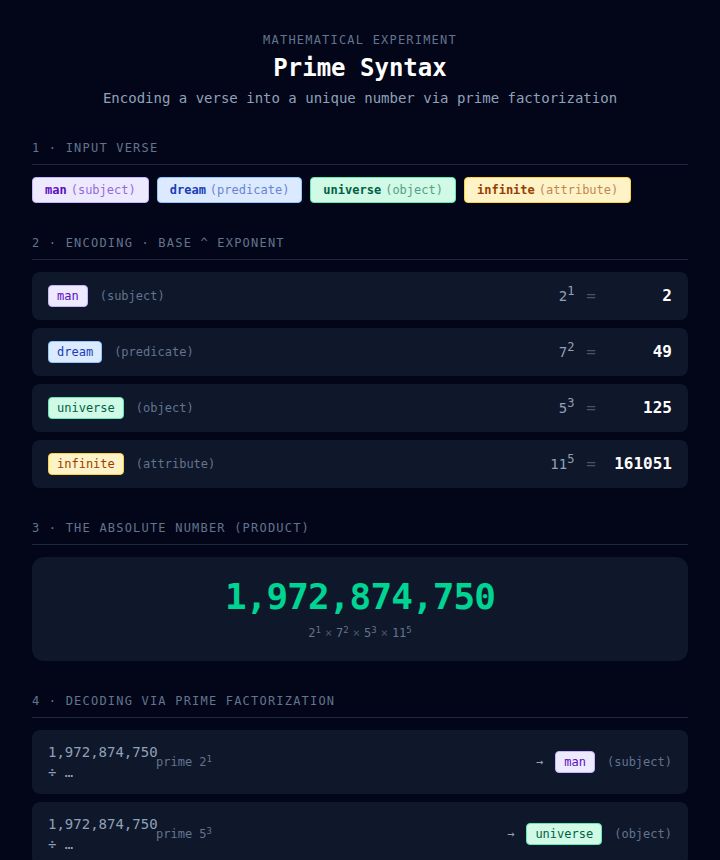
Consider the sentence “The man dreams the infinite universe.” It is decomposed syntactically and converted into numerical values.
- “The man” is the subject, producing base 2 to the first power, with the value $2^1$
- “Dreams” is the predicate, producing base 7 to the second power, with the value $7^2$
- “The universe” is the direct object, producing base 5 to the third power, with the value $5^3$
- “Infinite” is an attribute for universe, producing base 11 to the fifth power, with the value $11^5$
The mathematical equation of this verse is the product of these exact terms:
$$V = 2^1 \times 7^2 \times 5^3 \times 11^5$$
The calculation yields a massive absolute value:
$$V = 2 \times 49 \times 125 \times 161,051 = 1,972,874,750$$
Here the true poetry of syntax manifests itself. The number 1,972,874,750 is no longer a meaningless quantitative string. It contains within itself the entire meaning of the sentence, the hierarchy of action, and the geometry of thought.
To decode this poem, one needs only a factorization algorithm. The Fundamental Theorem of Arithmetic states that any natural number greater than 1 has a unique prime factorization.
Thus, the text cannot be misread or corrupted by subjective translations. Its mathematical reading offers a perfect and singular restoration of the original intent.
Spatializing Syntax
The system requires an additional rule to prevent algebraic collapse when semantics repeat.
A sentence with recurrent terms, such as “The man dreams the man”, forces exponent addition when identical bases are multiplied.
Thus, the original meaning is irreversibly lost through mathematical simplification. To isolate each syntactic function, the model adopts the positional principle from Gödel numbering, an absolute sequential encoding technique.
The sentence formula receives a chronological dimension. The intrinsic value of the word, previously computed as $p^f$, becomes the exponent of a meta-base.
These meta-bases are simply the first prime numbers in the natural sequence (2, 3, 5, 7, 11), allocated strictly according to the order of word appearance in the text.
The new absolute equation takes the form:
$$N = 2^{v_1} \times 3^{v_2} \times 5^{v_3} \dots$$
where $v$ denotes the unique semantic value $p^f$ of each term.
Thus, the sentence “The man dreams the man” is now computed with no destructive overlap.
- The first term, the subject “The man”, has the value $2^1$ and occupies the first position, fixing meta-base 2. It produces the mathematical element $2^2$.
- The second term, the predicate “dreams”, computed at the value $7^2 = 49$, occupies the second position, associated with meta-base 3. It produces the element $3^{49}$.
- The third term, the direct object “the man”, evaluated at $2^3 = 8$, occupies the third position, requiring meta-base 5. It produces the element $5^8$.
The final poem is the product:
$$N = 2^2 \times 3^{49} \times 5^8$$
This astronomical number guarantees the text’s total integrity. The Fundamental Theorem of Arithmetic will always extract order, meaning, and precise grammatical function. Consequently, the message remains intact regardless of repetition within a poem.
The Intersection between Numbers and Artificial Intelligence
This mathematical modeling of grammar exceeds the status of a mere theoretical or poetic exercise. It fundamentally reflects how artificial intelligence and large language models (LLMs) operate.
Deep neural networks do not recognize letters or poetry via human reception. An AI system processes information through tokenization, an automated procedure that converts text fragments into unique numeric identifiers, very similar to our prime dictionary.
These numbers are then projected into a multidimensional vector space, known in computer science as latent space. The word “infinite” ceases to be an abstract concept. It becomes an exact geometric coordinate in a topology of thousands of dimensions.
In this internal mathematical architecture of AI, terms with related meanings are grouped geometrically at small Euclidean distances from one another.
Grammar and syntactic subordination are no longer handbook rules. They are computed using attention mechanisms, as direction vectors and cosine distances between these coordinates.
An AI “understands” the meaning of a poem by effectively calculating the intersections and probabilities of these vectors in N-dimensional space. Prime Syntax represents an analogical and deterministic equivalent of these natural language processing (NLP) algorithms.
Both systems validate a deep philosophical thesis. Beneath any spoken language lies a purely quantitative structure, a set of coordinates that both the divine and the programmer use to generate reality.
Poetry does not vanish when mathematically quantified. It is purified, freed from phonetic ambiguity, and reduced to its perfect analytical proportion.
Algorithmic Implementation of the Numerical Language
The following Python script validates the theoretical mechanics of Prime Syntax. The algorithm functions as a bidirectional decoder. It transforms a sentence into its absolute number and uses the Fundamental Theorem of Arithmetic to extract the poem back from the number. See the code below verified in Replit.
# 1. Semantic Vocabulary (Prime Numbers)
vocab_prime = {
'man': 2,
'exist': 3,
'universe': 5,
'dream': 7,
'infinite': 11
}
inverse_vocab = {v: k for k, v in vocab_prime.items()}
# 2. Syntactic Architecture (Fibonacci Exponents)
fibonacci_syntax = {
'subject': 1,
'predicate': 2,
'object': 3,       # direct object
'attribute': 5     # attribute / modifier
}
inverse_syntax = {v: k for k, v in fibonacci_syntax.items()}
def encode_poem(structured_sentence):
"""
Transform a grammatical structure into the Absolute Number.
Uses the product of prime factors raised to Fibonacci exponents.
"""
absolute_number = 1
for word, function in structured_sentence.items():
base = vocab_prime[word]
exponent = fibonacci_syntax[function]
absolute_number *= (base ** exponent)
return absolute_number
def decode_poem(absolute_number):
"""
Factor the number into primes to restore the poem.
Restoration is precise thanks to the Fundamental Theorem of Arithmetic.
"""
import sympy
factors = sympy.factorint(absolute_number)
decoded = []
for base, exponent in factors.items():
word = inverse_vocab.get(base, "[Unknown Concept]")
function = inverse_syntax.get(exponent, "[Unknown Syntax]")
decoded.append(f"{word} ({function})")
return " | ".join(decoded)
# --- Algorithm Validation ---
verse = {
'man': 'subject',
'dream': 'predicate',
'universe': 'object',
'infinite': 'attribute'
}
poem_number = encode_poem(verse)
print("--- Processing Prime Syntax ---")
print(f"The number that contains the poem is: {poem_number}")
print(f"Restoring the text by factorization: {decode_poem(poem_number)}")
Executing this code demonstrates the proposed topological accuracy. A simple factorization algorithm instantly reconstructs the entire architecture of the original thought.
Here is the result:
There is no information loss. There is only a consummate harmony between logic, computational mechanics, and the aesthetics of language.
Scientific and Philosophical References:
- https://plato.stanford.edu/entries/goedel/
- https://plato.stanford.edu/entries/leibniz-logic-influence/
- https://mathworld.wolfram.com/FundamentalTheoremofArithmetic.html
- https://mathworld.wolfram.com/FibonacciNumber.html
- https://xlinux.nist.gov/dads/HTML/quicksort.html
- https://developers.google.com/machine-learning/crash-course/embeddings/video-lecture
- https://arxiv.org/abs/1706.03762
Cover Photo by A Chosen Soul