

Silence is not merely a simple absence of sound in the auditory space. It is a perfectly defined mathematical structure. It represents a state of absolute equilibrium in which vibrations cancel each other out through perfect symmetry.
Instrumental compositions, such as the melancholic resonance of the cello in The Geometry of Silence, use this absence as an invisible canvas. Emotion is shaped precisely on this void.
The geometry of silence analyzes exactly this form of rest. It translates acoustic void into an objective and computable equation.
Silence obeys clear physical and mathematical laws. Thus, it acts as the foundation for any signal-processing system. The study of this geometry requires isolating the concept of noise. It also demands defining the space in which no new information perturbs the medium.
Table of Contents
Existence and Uniqueness of Absolute Silence
The geometry of silence is defined through the topological study of systems in total informational equilibrium. This form of silence exists truly and objectively in higher mathematics. In linear algebra, the concept is known as the null space or kernel.
The null space, a precise vector subspace, contains all elements that result in the zero value when passed through a matrix transformation.
Therefore, silence becomes the inevitable destination of seemingly chaotic forces. A transformation matrix, the absolute filter of mathematical reality, strictly cancels the noise of the world.
Geometric silence is unique by definition. In a vector space, the zero vectoris the central axis of any coordinate system. It is completely devoid of magnitude and direction and it’s unique.
Any other value implies motion, friction, and implicitly, sound. For this reason, silence does not admit a plural form in its pure mathematical sense.
There exists a single absolute Zero. Similarly, thermodynamics recognizes a single lower bound of temperature which is zero kelvin. It is the point where thermal agitation ceases and entropy reaches the lowest possible threshold.
Fundamental Properties of the Theorem
The Theorem of Geometric Silence is formally expressed by defining the mathematical kernel of a transformation:
$$\mathcal{S} = \ker(T) = \{ \mathbf{x} \in \mathbb{R}^n \mid T(\mathbf{x}) = \mathbf{0} \}$$
Translated into natural language, the theorem postulates a central axiom of dynamical systems. In a multidimensional space, absolute silence ($\mathcal{S}$) represents the set of all vectors of noise and motion ($\mathbf{x}$). These vectors cancel one another when passed through the filter of observable reality ($T$). Consequently, they irreversibly converge toward absolute zero ($\mathbf{0}$).
This theorem possesses three essential mathematical properties.
1. Null informational entropy
$$H(\mathcal{S}) = – \sum_i P(x_i) \log_2 P(x_i) = 0$$
Shannon entropy reaches zero in the absence of any signal source.
Silence is completely predictable. It offers no statistical surprise to the observer, and it consumes no informational bandwidth.
2. Total topological absorption
$$\lim_{t \to \infty} \Phi(\mathbf{v}(t)) = \mathbf{0}, \quad \forall \mathbf{v} \in \mathcal{S}$$
A point of silence acts topologically as a strange attractor. Any noise vector multiplied by the null matrix is instantaneously and irreversibly annihilated.
The system absorbs entropy and restores the original order. Thus, it forever erases the history of prior noise.
3. Stability through destructive interference
$$\Psi_{\text{total}} = A \sin(\omega t – kx) + A \sin(\omega t – kx + \pi) = 0$$
The Fourier transform decompose complex waves. It shows that absolute silence can be obtained by superposing two identical sound waves that are exactly 180 degrees (or $\pi$ radians) out of phase.
The waves continue to exist. However, their algebraic sum is zero. Silence becomes an active effort, a tense equilibrium of opposites.
Silence in the Latent Space of Artificial Intelligence
The geometry of silence finds a direct and surprising application in the modern architecture of artificial intelligence.
A deep learning model constantly faces a massive amount of redundant data, a permanent digital noise. Neural networks must learn the algorithm of silence to make correct predictions in the real world.
Mathematical regularization, a technique used to penalize excessive weights in a neural network, actively forces a large portion of matrix parameters to approach the zero value. The algorithm effectively silences useless neurons.
The loss function constantly seeks the zero gradient, the absolute minimum point of the multidimensional error surface. This minimum point, a precise topological depression in latent space, is the mathematical equivalent of perfect silence.
A properly trained AI model no longer oscillates when presented with new data. It reaches a quiet equilibrium. From this state, it emits an instant, clear decision.
Therefore, the absence of irrelevant activity in artificial intelligence represents supreme clarity.
Dropout, the process of deliberately deactivating neurons, introduces small nuclei of forced silence directly into the network architecture. The algorithm prevents mechanical memorization of the dataset. It boldly compels the network to generalize efficiently.
Artificial silence thus becomes a filter of objective truth. The AI learns the essence. It ignores distortions and background noise.
Mathematical Implementation of the Null Space
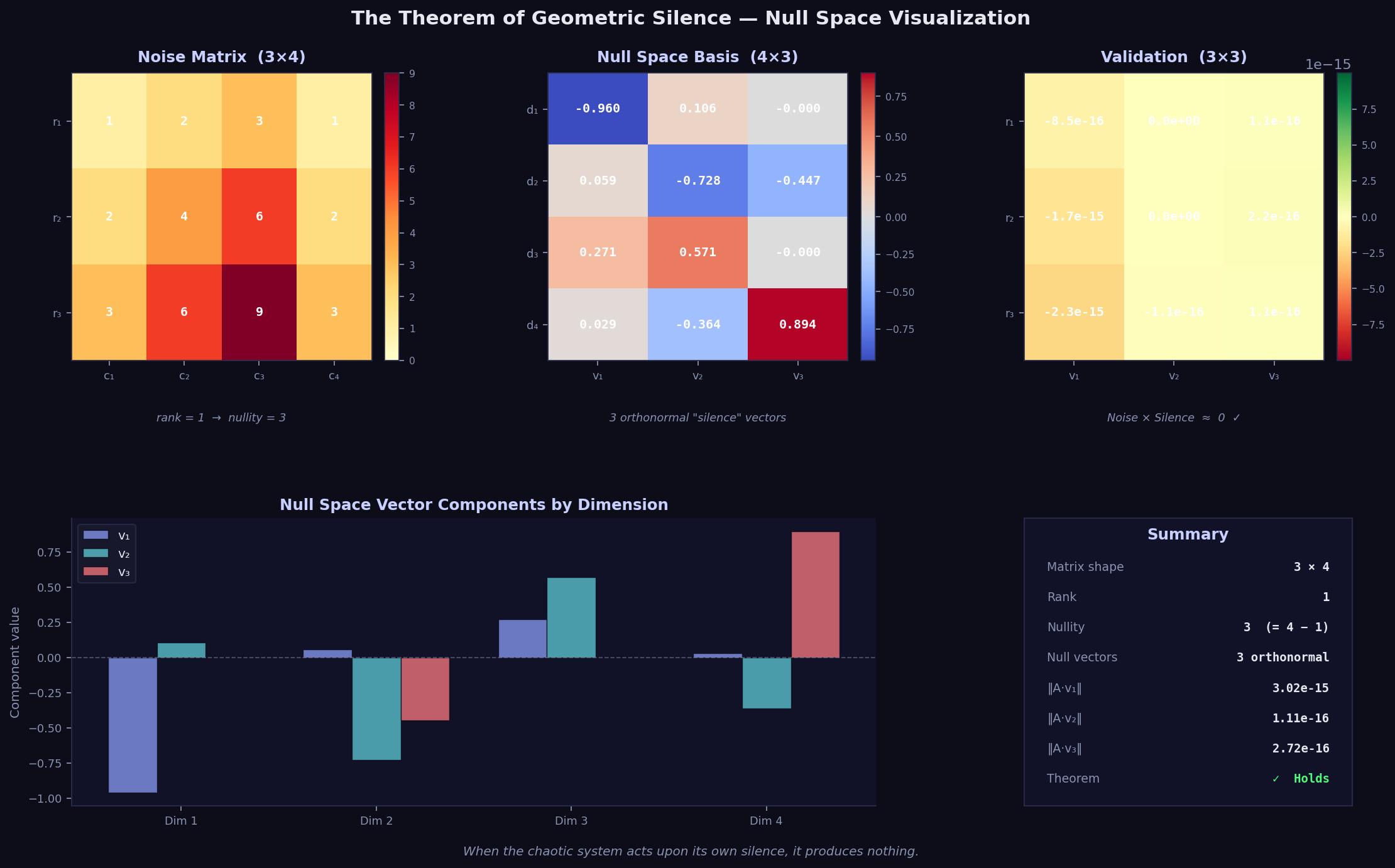
We propose an algorithm to validate this theory within an applied computational environment. This model extracts the state of “silence” (the null space) from an apparently noisy set of linear algebraic equations.
The algorithm uses the null_space function from the scientific library scipy.linalg.
The module identifies the exact vectors that completely cancel matrix noise. It gracefully reduces the result of the equation to a pure geometric silence. See the Python code executed wit Replit.
import numpy as np
from scipy.linalg import null_space
# 1. Defining the Noise Matrix (The Chaotic System)
# This matrix represents a linear transformation that distorts reality
noise_matrix = np.array([
[1, 2, 3, 1],
[2, 4, 6, 2],
[3, 6, 9, 3]
])
print("--- The Theorem of Geometric Silence ---")
print("The original noise matrix (The system of forces):")
print(noise_matrix)
# 2. Extracting the Silence (Calculating the Null Space)
# The null_space function identifies the exact vectors that completely cancel the noise
geometry_of_silence = null_space(noise_matrix)
print("\nThe vectors of silence (The calculated Null Space):")
# Rounding the values for a clearer display of the topology
print(np.round(geometry_of_silence, 3))
# 3. Validating the Theorem (The Property of Topological Absorption)
# We multiply the noisy system by the vectors of silence to demonstrate the cancellation
destructive_interference = np.dot(noise_matrix, geometry_of_silence)
print("\
This model visually demonstrates the process by which mathematics filters chaos. Executing the code proves the topological rigor of the null space. It generates complex vectors that leave behind only a deafening silence. This absence is calculated and irrevocable through direct interaction with the noisy system.
Here is the visual of the code’s output.
Enjoy the Geometry of Silence:
Sources:
- https://mathworld.wolfram.com/NullSpace.html
- https://plato.stanford.edu/entries/information-entropy/
- https://www.deeplearningbook.org/
- https://developers.google.com/machine-learning/crash-course/embeddings/video-lecture
- https://docs.scipy.org/doc/scipy/reference/generated/scipy.linalg.null_space.html
Cover Photo by Ayaakii