

The simulation hypothesis reduces human and universal existence to a computational process. It proposes that matter and time are mere data processing.
This vision, although popular in digital culture, ignores the insurmountable logical and physical barriers separating an algorithmic system from created reality.
The universe does not function as finite source code; it possesses and generates structures that defy the limits of any computational architecture, being anchored in an incomputable complexity.
Kurt Gödel’s Incompleteness Theorem represents the first major obstacle to this hypothesis. Gödel demonstrated that within any coherent formal system, true propositions exist that cannot be validated using exclusively the rules of that system.
A Matrix would be, by definition, a closed formal system.
The reality we observe, however, possesses a vertain depth suggesting the source of truth is transcendent to the system, not internal to it. The universe does not calculate itself in a logical loop but participates in a Truth exceeding any binary coding.
Table of Contents
Transcendental Limit and the Cardinality Gap
The nature of irrational and transcendental numbers, such as $\pi$, precisely and clearly demonstrates the limitations of digital processing.
In a simulation, any value must be stored in a finite memory, forcing the system to operate at a discrete resolution.
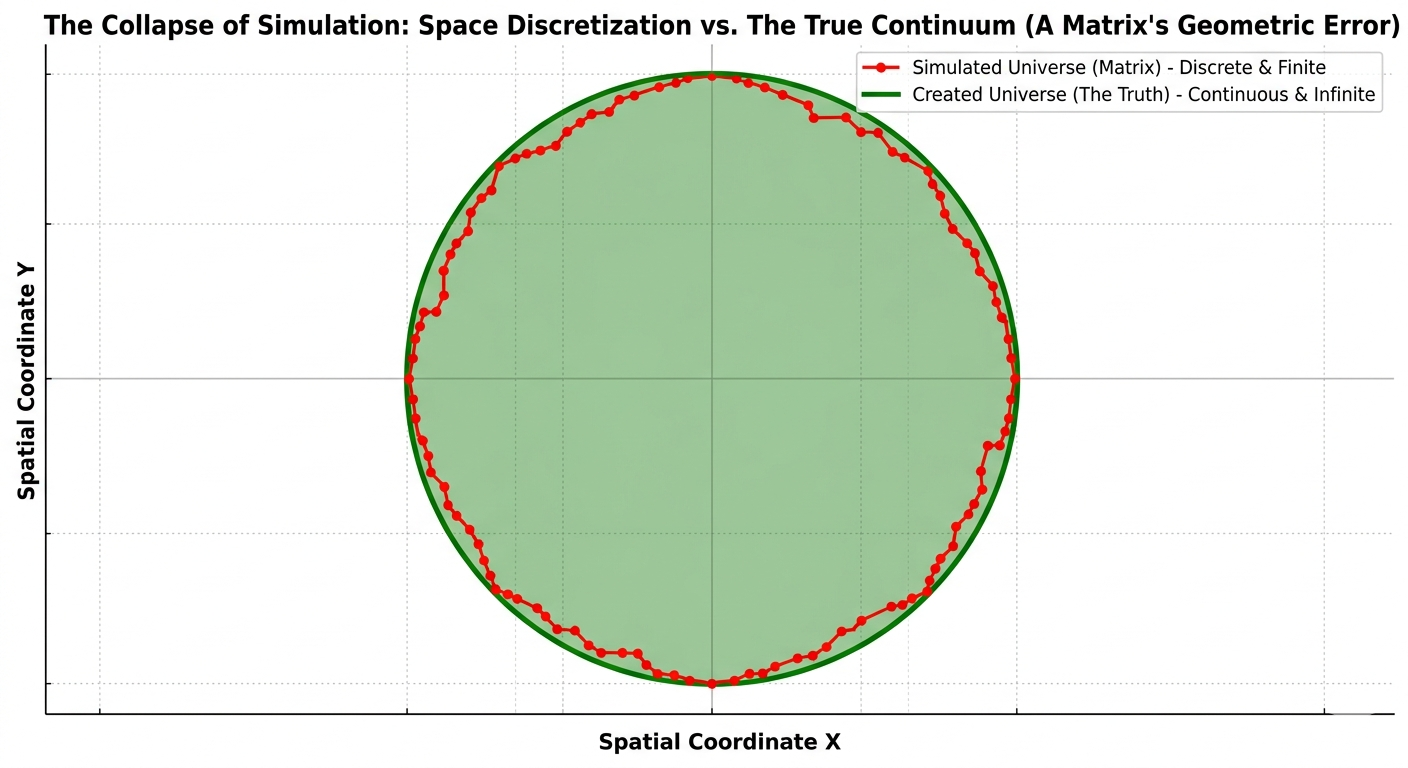
A perfect circle, for example, could not exist in a Matrix, being broken down into finite processing units. Physical reality, however, relies on the infinite precision of these constants.
The universe does not approximate values to save resources but generates a density of the real that increases as we descend toward the infinitesimal level.
This density is closely linked to the cardinality gap. Computer science operates with countable datasets, specific to any finite algorithm. Fundamental physical fields take values in uncountable spaces, possessing an infinite number of degrees of freedom.
A finite simulation cannot mathematically represent a perfect analog continuum without resorting to simplifications that would be experimentally detectable. The world is an uncountable structure, whereas any Matrix would merely be a digital approximation of a higher truth.
Incomputability and Chaitin’s Constant
The existence of incomputable mathematical objects demonstrates that the universe does not “run” lines of code. The halting probability of a Turing machine, defined by Gregory Chaitin as Omega’s Constant ($\Omega$), is a real number with a purely random character.
No computer program is capable of generating the decimals of $\Omega$, although its value is an objective mathematical truth. In a simulation, any event would be dictated by a central processor, eliminating the possibility of incomputability.
Quantum phenomena, such as wave function collapse, involve stochastic processes that evade any rigid determination. These manifestations are non-algorithmic objects, impossible to capture in an “if-then” sequence of instructions.
The presence of incomputability in reality demonstrates that the universe manifests freely. It exceeds the reach of any programming language, being a work that does not depend on automated execution.
Physical Barriers: Bekenstein and Informational Entropy
Any hardware supporting a universe simulation would hit the limits of thermodynamic physics. The Bekenstein bound establishes an absolute upper threshold for the amount of information that can be contained in a finite region of space with a given energy.
To precisely simulate the structure of the entire universe, the information density would exceed the capacity of any physical medium, transforming the device into a black hole.
The energetic resource required to maintain a simulation at the scale of observable reality is incompatible with known laws.
The universe shows no signs of dimensionality reduction, a mandatory phenomenon in computer science to make a system computable. Simulations are inevitably more granular and less detailed than the host reality.
Our world does not save its “RAM memory,” consuming its splendor in infinitesimal details that serve no technical utility, but solely the beauty of creation.
The Distinction Between Transfinite and Absolute Infinite
We can turn to Georg Cantor’s distinction between the Transfinite and the Absolute Infinite.
In a Matrix, we could only encounter transfinite numbers, infinite sets that can be manipulated and increased within a system.
The Absolute Infinite, which Cantor identified with the divine nature, represents the ultimate conceptual limit, situated beyond any progression. A simulation would always remain trapped in the sphere of the transfinite, incapable of reaching or reflecting the Absolute.
The created universe, however, bears within itself the imprint of this Absolute Infinite, manifested through immutable mathematical order and the convergence toward a transcendent meaning. The experience of the sacred is an indication of humanity’s connection with a reality that cannot be reduced to data.
Human consciousness, with its subjective experience, remains impassable for any algorithm. A program can simulate reactions, but it cannot generate the tense experience of the spirit between the finite and the infinite.
The Architecture of Created TruthThe universe cannot be a Matrix because its mathematics is too rich to be contained by a finite system.
Understanding the world as Creation offers a much more aesthetic and robust explanation than that of a Matrix. Creation is an act of freedom, while simulation is an act of technical necessity.
We are not lines of code in a virtual scenario, but the inhabitants of a divine reason embedded in the very fabric of reality.
The world is the temple of an infinite intelligence that we decipher through the rigor of mathematics, poetry, and faith.
Here is a Python code as to our subject:
import numpy as np
import matplotlib.pyplot as plt
def genereaza_comparatie_ontologica():
# 1. Universul Creat (Adevărul Continuu)
# Utilizăm o rezoluție extrem de mare pentru a simula infinitul analogic
theta_continuu = np.linspace(0, 2 * np.pi, 10000)
x_continuu = np.cos(theta_continuu)
y_continuu = np.sin(theta_continuu)
# 2. Universul Simulat (Matrix)
# Un sistem digital este limitat la pași de procesare discreți (grid_resolution)
rezolutie_grid = 10
theta_discret = np.linspace(0, 2 * np.pi, 40)
x_matrix_brut = np.cos(theta_discret)
y_matrix_brut = np.sin(theta_discret)
# Cuantificăm coordonatele.
# Simularea rotunjește valorile iraționale din cauza memoriei finite.
x_matrix = np.round(x_matrix_brut * rezolutie_grid) / rezolutie_grid
y_matrix = np.round(y_matrix_brut * rezolutie_grid) / rezolutie_grid
# 3. Crearea Vizualizării Grafice
fig, ax = plt.subplots(figsize=(10, 10))
# Trasarea realității simulate (discretă, plină de erori de trunchiere)
ax.plot(x_matrix, y_matrix, drawstyle='steps-mid', color='#d62728', linewidth=2.5,
label='Universul Simulat (Matrix) - Discret & Finit', alpha=0.9)
ax.scatter(x_matrix, y_matrix, color='red', s=40, zorder=5, label='Noduri de Procesare')
# Trasarea realității create (continuă, perfectă)
ax.plot(x_continuu, y_continuu, color='#2ca02c', linewidth=3.5,
label='Universul Creat (Adevărul) - Continuu & Infinit')
# Personalizarea esteticii matematice
ax.set_title('Colapsul Simulării: Discretizarea Spațiului vs. Continuumul Adevărat\n(Eroarea Geometrică a unui Matrix)',
fontsize=14, fontweight='bold', pad=20)
ax.set_xlabel('Coordonata Spațială X (Dimensiune Fizică)', fontsize=12)
ax.set_ylabel('Coordonata Spațială Y (Dimensiune Fizică)', fontsize=12)
# Liniile de axă și grila de fundal
ax.axhline(0, color='black', linewidth=1, alpha=0.3)
ax.axvline(0, color='black', linewidth=1, alpha=0.3)
ax.grid(True, linestyle=':', alpha=0.6)
# Legenda și proporțiile
ax.legend(loc='upper right', fontsize=11)
ax.axis('equal')
plt.tight_layout()
plt.show()
if __name__ == "__main__":
print("Se calculează decalajul de cardinalitate...")
genereaza_comparatie_ontologica()
Here is the visual output:
Sources:
- https://arxiv.org/abs/1605.01041
- https://plato.stanford.edu/entries/goedel-incompleteness/
- https://www.scientificamerican.com/article/information-in-the-holographic-universe/
- https://mathworld.wolfram.com/ChaitinsConstant.html
- https://plato.stanford.edu/entries/set-theory/
- https://plato.stanford.edu/entries/continuity/
Cover photo by Markus Spiske
Please also read:
https://eticasintetica.com/pi-beyond-the-geometry-of-the-circle-in-the-architecture-of-intelligence/